What to Do in Arraial do Cabo
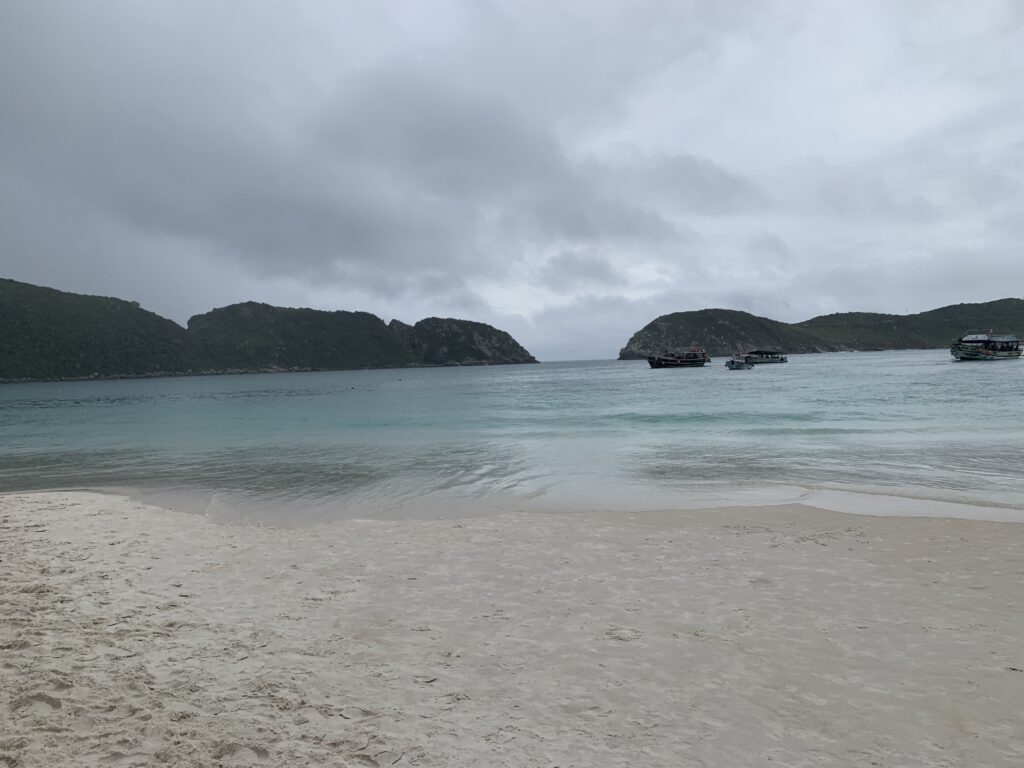
Arraial do Cabo is known as the “Brazilian Caribbean” and also as the “Diving Capital,” thanks to its crystal-clear water in various shades of turquoise, with the ocean as the town’s biggest draw.
It’s part of Rio de Janeiro’s Região dos Lagos, along with Búzios and Cabo Frio, both beautiful regions in their own right, though the best beaches are in Arraial.
Arraial do Cabo’s beaches rank among Brazil’s top 5, according to TripAdvisor’s Travellers’ Choice list — Pontal do Atalaia, Praia do Farol, and Praia do Forno, losing out only to Baía do Sancho, in Fernando de Noronha.
Even though the water here is cold, it’s worth braving for its clarity, and even on cloudy days, the ocean water stays impeccably clear.
There are 8 main beaches: Praia do Farol, Praia do Pontal do Atalaia, Praia do Forno, Prainha, Praia Grande, Praia Brava, Praia do Pontal, and Praia dos Anjos.
How to Get to Arraial do Cabo
The Região dos Lagos sits along the northern coast of Rio de Janeiro state.
Bus
Buses run from both Rio de Janeiro, with several daily departures, and São Paulo, with three daily departures from Estação do Tietê, operated by Viação 1001. Check schedules ahead of time.
Worth remembering, buses depart from Galeão Airport at various times. If you land at Santos Dumont, you’ll need to get to the Rodoviária Novo Rio.
Plane
There are two flight options: Gol flies direct from Guarulhos to Cabo Frio airport, currently running 3 times a week (Wednesday/Saturday/Sunday).
Or fly from São Paulo to Rio de Janeiro, then take a bus or rent a car from there — we chose the second option.
Car
Coming from Rio de Janeiro: after arriving at Galeão International Airport or Santos Dumont, from the city of Rio de Janeiro, follow BR-101, known locally as Avenida Brasil. Then take the Rio-Niterói Bridge, followed by RJ-124, the Via Lagos, until you reach your destination. There are two tolls: one at the Rio-Niterói Bridge, and another at km 22 of Via Lagos.
Coming from São Paulo: take BR-116, then Via Lagos (RJ-124). The route spans 575 km, taking around 8 hours. You can also go via BR-381, followed by BR-116 and Via Lagos, though that route takes about 11 hours and covers 717 km.
When to Go to Arraial do Cabo
Summer, from December to February, is peak season, and the Região dos Lagos is one of Brazil’s most sought-after destinations, so during this window, expect crowded beaches and higher prices.
Holidays and weekends also bring crowded beaches, partly because of demand from the city of Rio itself, running into the same inflated-price, crowded-beach issues as summer.
In winter, you might catch no rain at all, and the ocean water runs slightly less cold than usual — yes, you read that right, the water is less cold, since regardless of season, it’s always chilly there, and the factor behind this is upwelling, which makes the water less cold in winter and colder in summer.
Where to Stay in Arraial do Cabo
We stayed at Pousada da Prainha — the rooms are good and spacious, though we had a noise issue with the air conditioning, along with a nice bathroom, hot shower, and a good pool.
Breakfast is good, though they don’t follow COVID-19 safety protocols. Guests don’t wear masks, and staff don’t enforce it either.
There’s also a kids’ playground at the hotel entrance.
It’s a decent place to stay as long as it’s not an especially hot day, since the noise makes it hard to sleep.
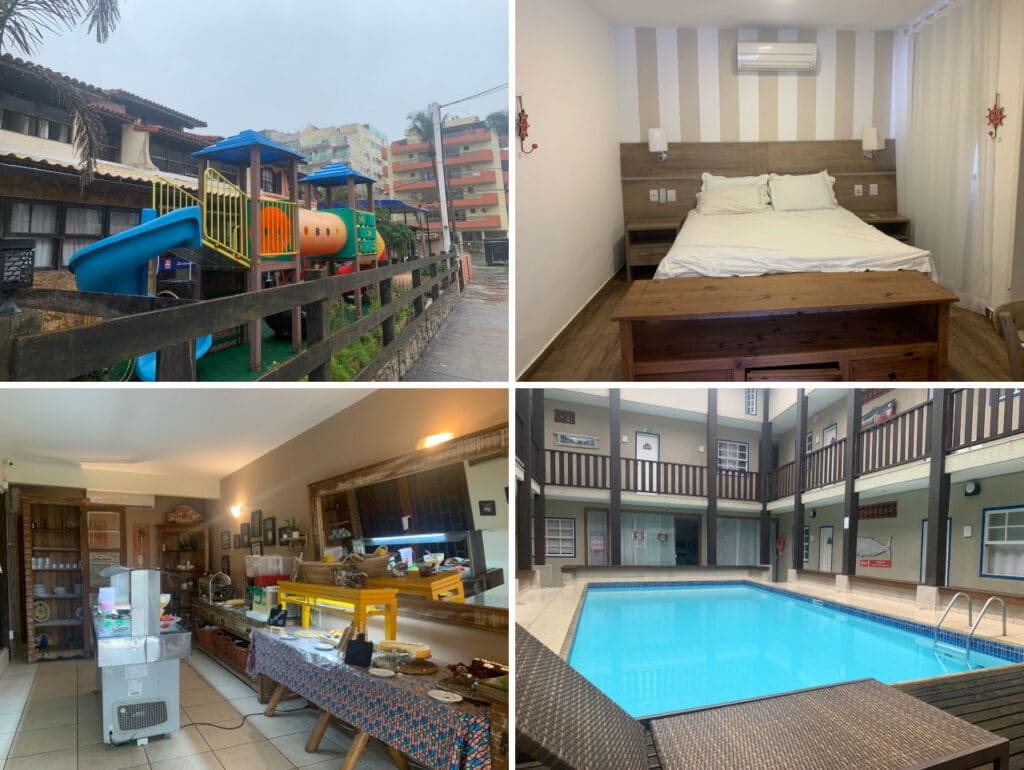 Pousada da Prainha, Arraial do Cabo
What to Do in Arraial do Cabo
Obviously, seeing the beaches is the simplest answer, and if that’s all you do, the trip will already be wonderful. I think the second option is the boat tour, running three to four hours. It’s a great pick, since it’s the only way to reach Praia do Farol — but we’ll describe both in more detail below.
Boat Tour in Arraial do Cabo
We took the tour with Arraial Vip (Instagram). The itinerary includes, beyond a 40-minute stop at Praia do Farol, passing by Gruta Azul, the Fenda Nossa Senhora da Assunção, Pedra do Macaco, and the Buraco do Meteorito, a one-hour stop at Praia do Pontal do Atalaia, where it’s worth walking to Gruta do Amor, and a final 20-minute snorkeling stop in the waters off Praia do Forno, though you don’t actually get off the boat onto the beach there.
Boats generally depart from Praia dos Anjos, and the tour costs about R$100.00 per person, plus a R$10.00 boarding fee paid on site. There are boats for every taste, with or without music, varying in group size, and some even have a water slide.
We think the boat tour is well worth it, especially to see Praia do Farol, which, under Brazilian Navy protection, has limited access. To get there, you need to book one of the authorized tours, and only 250 visitors are allowed on the beach at a time, every 45 minutes.
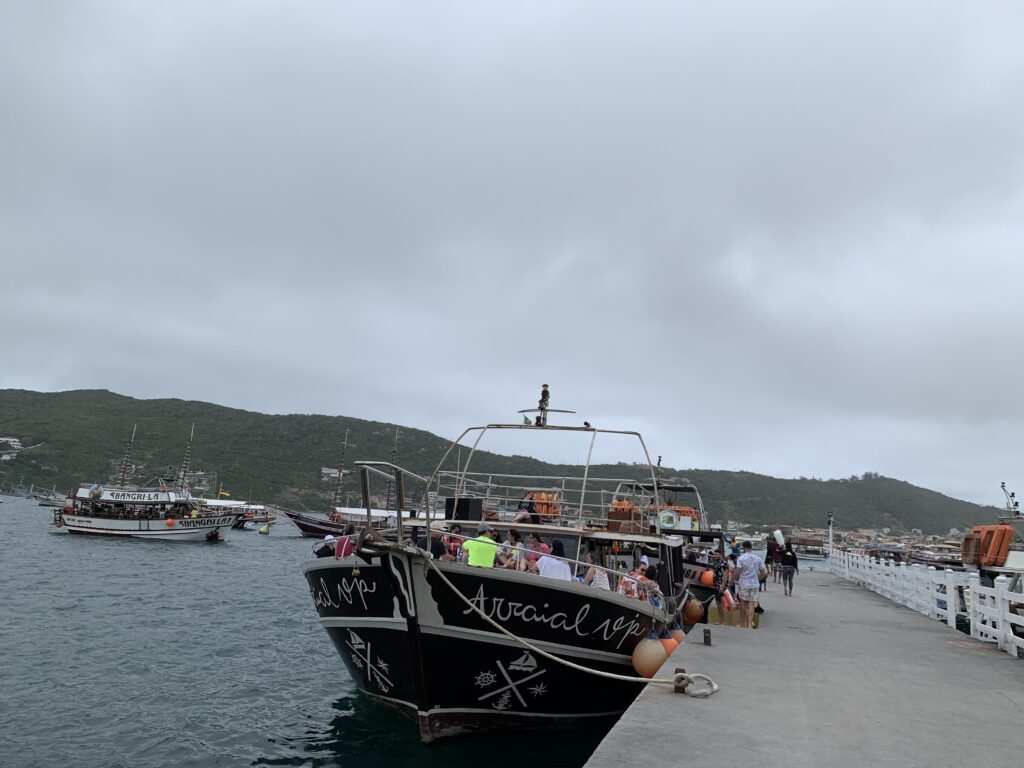 Arraial Vip boat
Praia do Farol
Praia do Farol sits on an island, so access is by authorized boat only, and it’s known for being classified by INPE (National Institute for Space Research) as one of the most perfect beaches in the country, based on criteria like water purity, sand quality, and scenery.
The beach area is protected for environmental reasons, but also because historical records of Arraial do Cabo show that Amerigo Vespucci’s nautical chart references the tree marking the center of the beach, and the Sambaqui archaeological site sits in the dunes further inland on the island, where the dead were once buried alongside tools used by Brazil’s earliest peoples.
We found it one of the most beautiful beaches, and it’s genuinely deserted. There are no vendors on site, just a wooden structure where the Navy monitors visitors. Only a small area is authorized for walking or swimming, since the rest is fenced off.
The island also has two lighthouses: an older, decommissioned one from 1836, sitting at the island’s highest point. Even from a distance, you can see its ruins. There’s also the Farol de Cabo Frio, opened in 1861, located on the rocky headland known as “Focinho do Cabo,” with a 90 km range. You can’t visit it, and unfortunately, we couldn’t spot it even from a distance during our boat tour.
Praia do Farol
Gruta Azul, Fenda Nossa Senhora Assunção, and Pedra do Macaco
Leaving Praia do Farol, the first stop for sightseeing is the Fenda de Nossa Senhora da Assunção, a rocky crevice roughly 5 meters wide and 40 meters tall.
As the story goes, a fisherman found the saint’s image in this crevice in 1721. It was carried in a solemn procession to the Nossa Senhora da Assunção church in Cabo Frio, since at the time Arraial do Cabo belonged to Cabo Frio. Today, a replica sits at the site, though it’s currently away for restoration, so the site is without an image at the moment.
Aboard the boat, guides tell passengers that any couple who kisses in front of the crevice will never be separated.
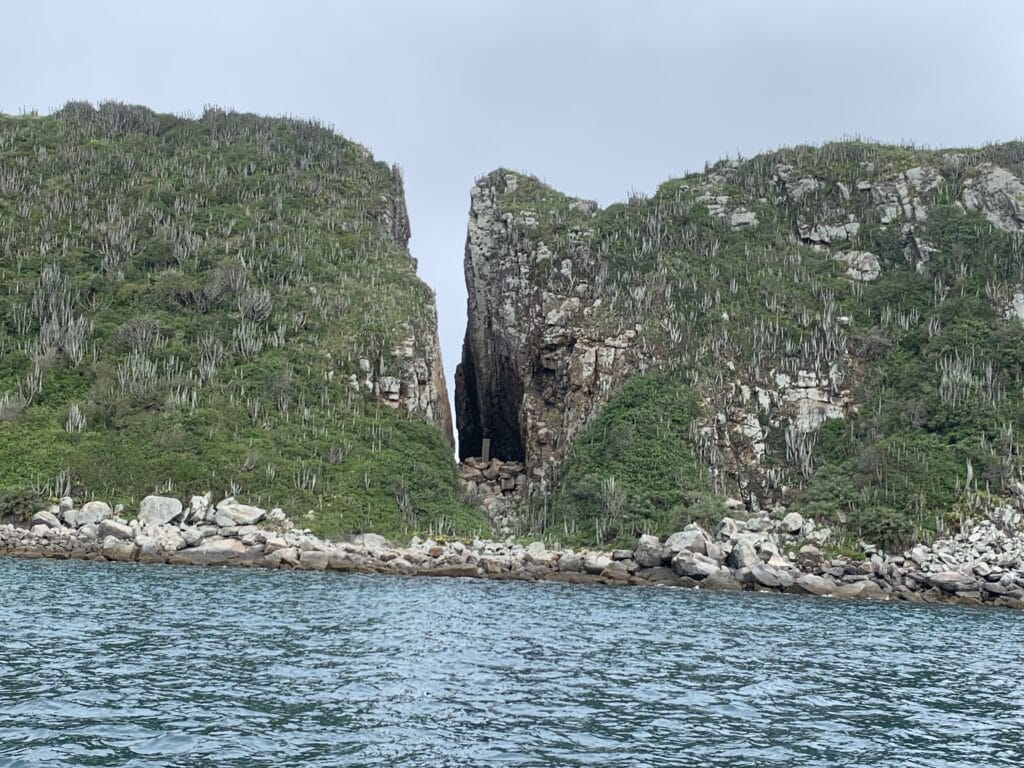 Fenda de Nossa Senhora da Assunção
Gruta Azul is viewed from outside, since boats don’t enter the cave. It gets its name because its walls take on a blue tone reflecting the water, though this only happens during very specific times of year, at sunrise, so you won’t see the phenomenon during the regular boat tour.
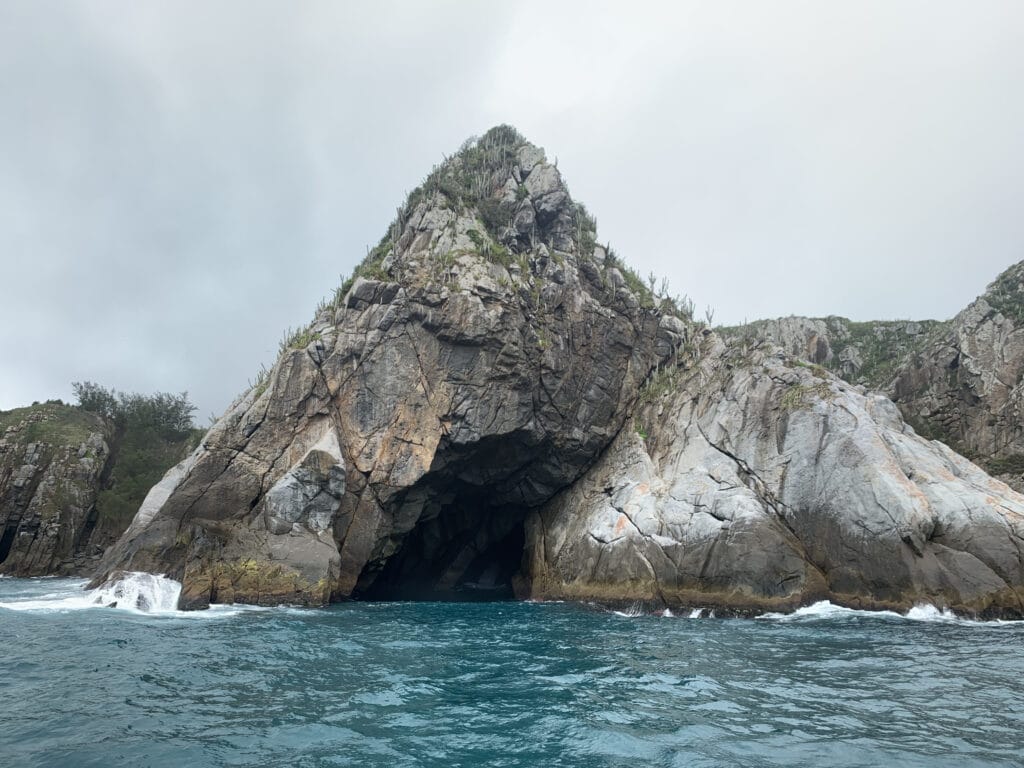 Gruta Azul
Another attraction is Cratera do Meteorito, named for the belief that an asteroid caused the crater. Local legend also claims it served as Osama Bin Laden’s vacation hideout during his flight from the Americans.
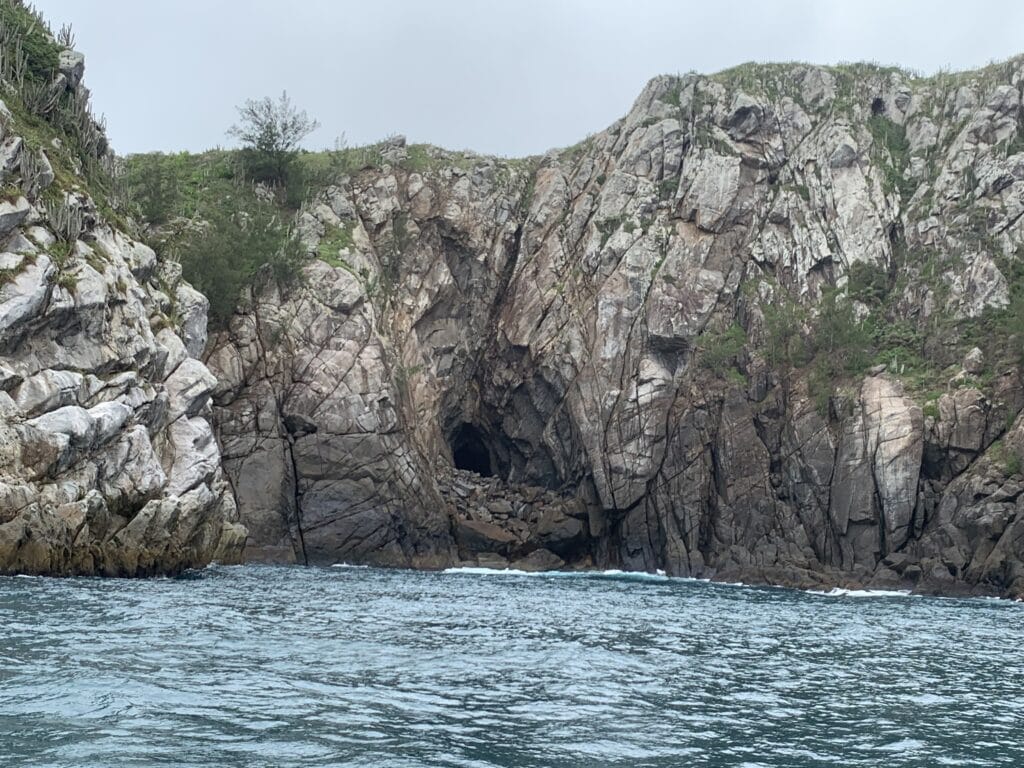 Cratera do Meteorito
Looking at Pedra do Macaco, you’ll see a monkey in profile — the resemblance is genuinely impressive, and it’s impossible not to take a photo.
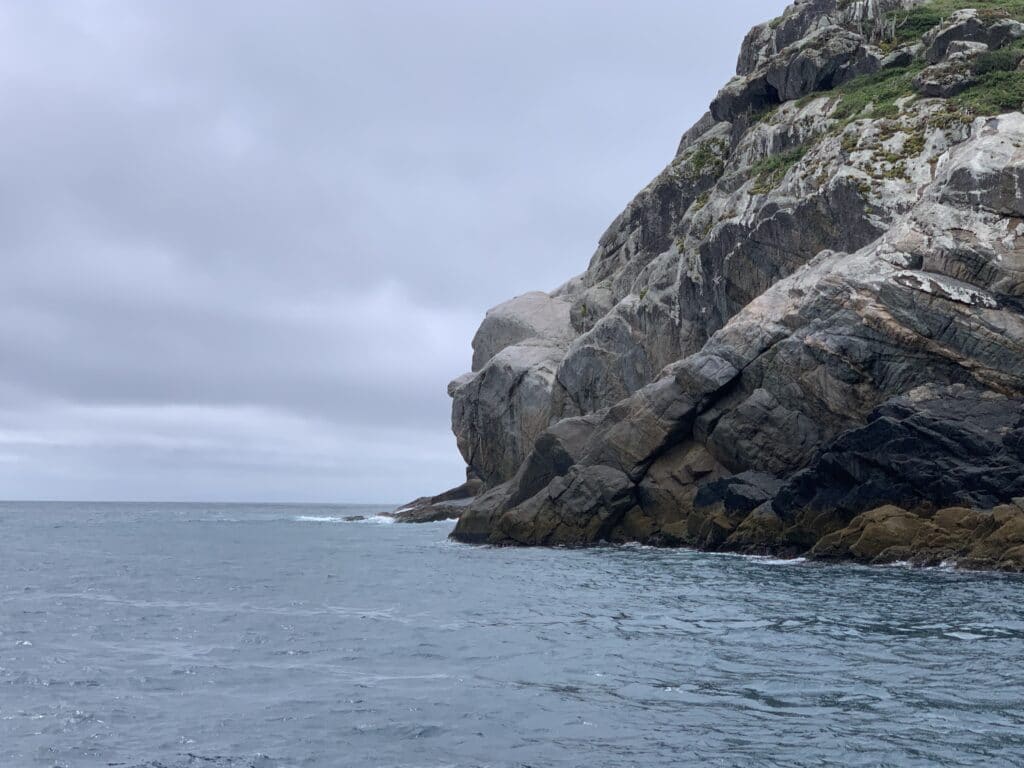 Pedra do Macaco
Prainhas Pontal do Atalaia
You can reach Prainhas Pontal do Atalaia two ways: by boat, or via a staircase that doubles as a lookout with a beautiful view! The Prainhas sit on Morro do Pontal do Atalaia and get their name since they’re made up of two beaches — though at low tide, they merge into a single stretch of sand.
There are three ways to reach the staircase: by taxi (the easiest option), driving your own car and parking at the condo (nearly impossible, since it only has 180 spots), or on foot, though the walk is nearly 6 km, quite winding, and dangerous because of car traffic, since the road is narrow and curvy.
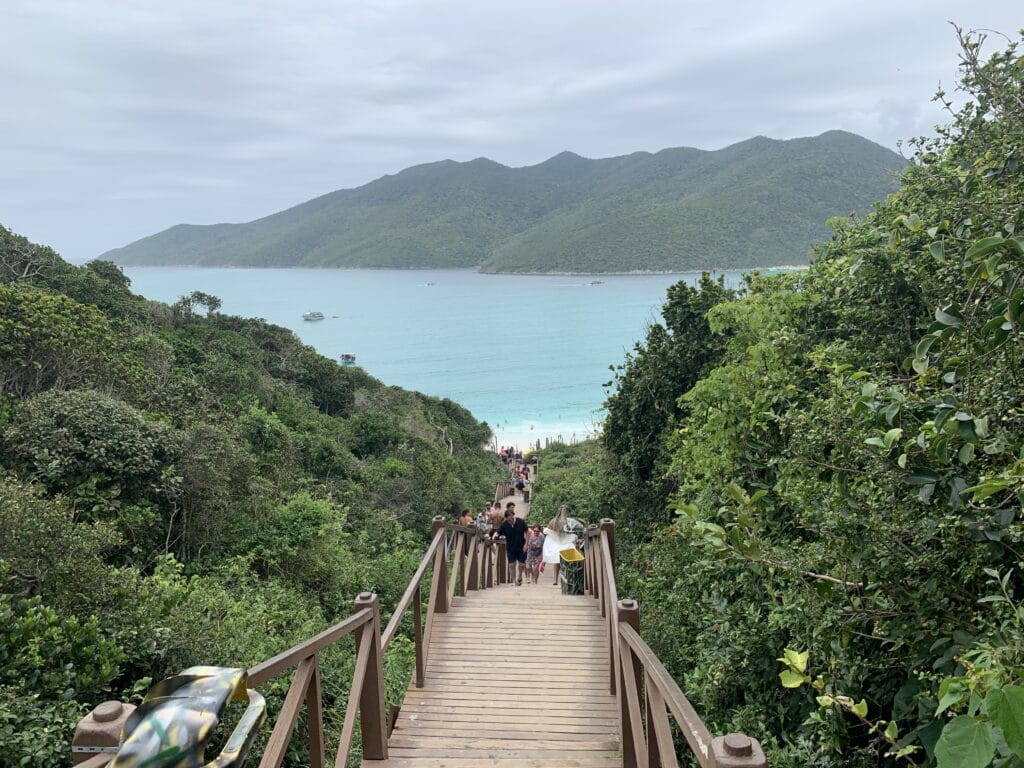 Staircase to Prainhas Pontal do Atalaia
How to Get to Praia do Pontal do Atalaia
We wouldn’t recommend Uber, since it doesn’t reach this location. Only taxis are authorized, and drivers charge R$15.00 per person one-way, and the same for the return trip.
Our own experience was driving there ourselves and parking on the street, though there are several parking lots nearby, and then taking a taxi to reach the staircase. The route also passes several beautiful photo spots, though the taxi doesn’t stop.
We took several photos, but by the time we reached the beach, it was packed, and they asked us for R$50.00 for a chair and umbrella to sit. We went on a holiday, though, and on regular weekdays without any special dates, it’s probably much more pleasant. Because of the crowds, we chose to leave.
If you go by boat, when you get off, you land on a part of the beach that doesn’t connect to the staircase once the tide is high, making the crossing dangerous. But on the left side of the beach (facing the ocean), there’s a small cave, the Gruta do Amor, a beautiful photo spot, especially from inside — and since the beach is full of legend, the cave is also said to hold the power to make a couple’s love eternal. Just be careful, since it’s only accessible at low tide.
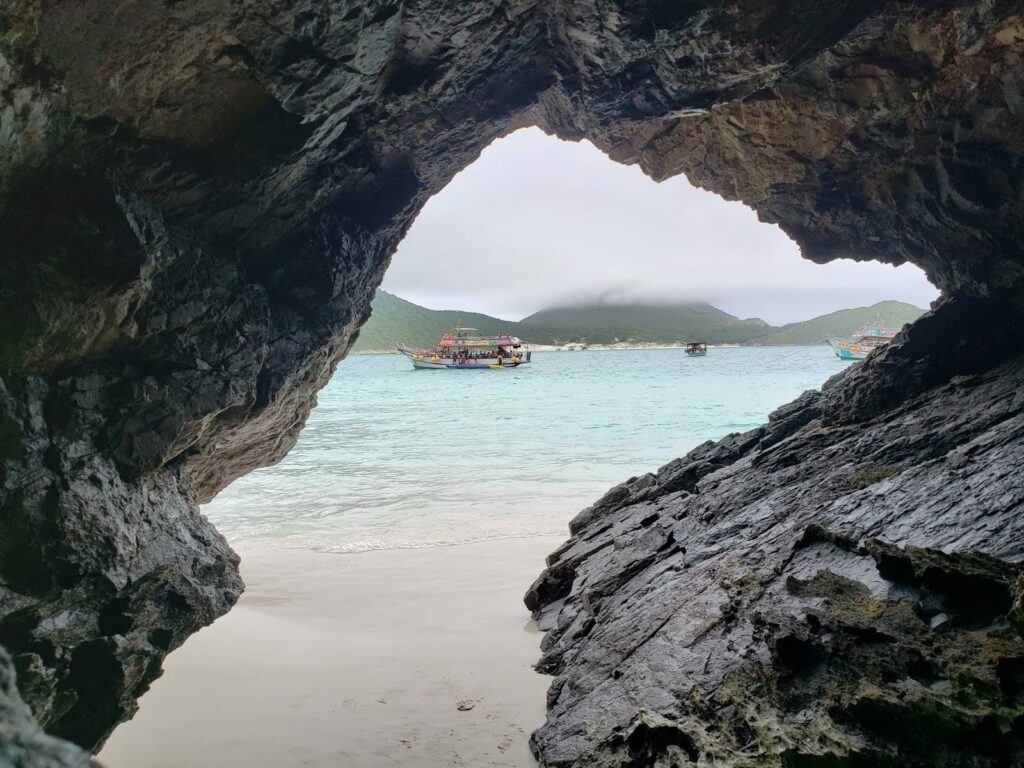 Gruta do Amor
Be careful not to confuse the Prainhas do Pontal do Atalaia with Prainha or Praia do Pontal, which sit on the same stretch of sand as Praia do Forte, in Cabo Frio.
But no matter how you reach the beach, it’s absolutely worth it, and we’d call it a must-see — even worth doing both tours!
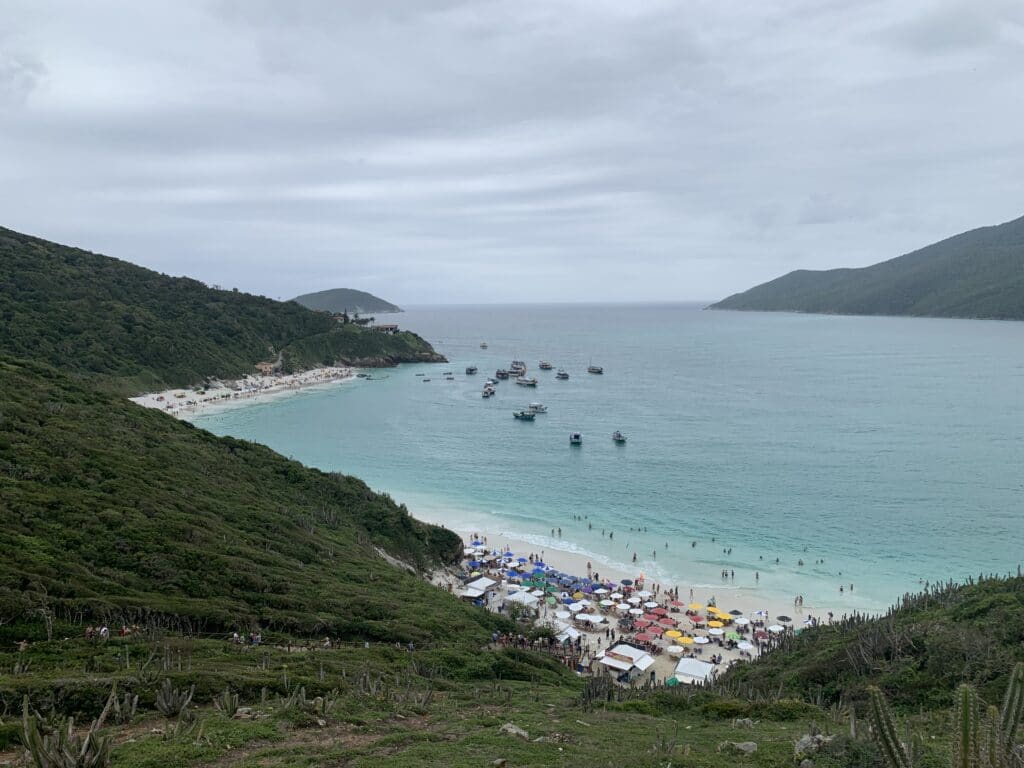 Prainhas Pontal do Atalaia
Praia do Forno
The two beaches mentioned above are beautiful, but Praia do Forno was, in my opinion, the best of all. It’s only accessible via a 500-meter trail, and even with an uphill stretch, it’s a very easy, light walk, taking about 20 minutes.
Nearly the whole trail has a lookout over the beach, and every one is beautiful — genuinely hard to pick just one! The beach itself is also short, with about 600 meters of sand, with small food stalls to spend the day.
You’ll come across some accounts mentioning boat access to this beach, but that’s no longer possible today. Boats stop at Praia do Forno for 20 minutes so passengers can dive in and swim near the boat.
There, you can snorkel to spot turtles and fish, though be careful of the cold water.
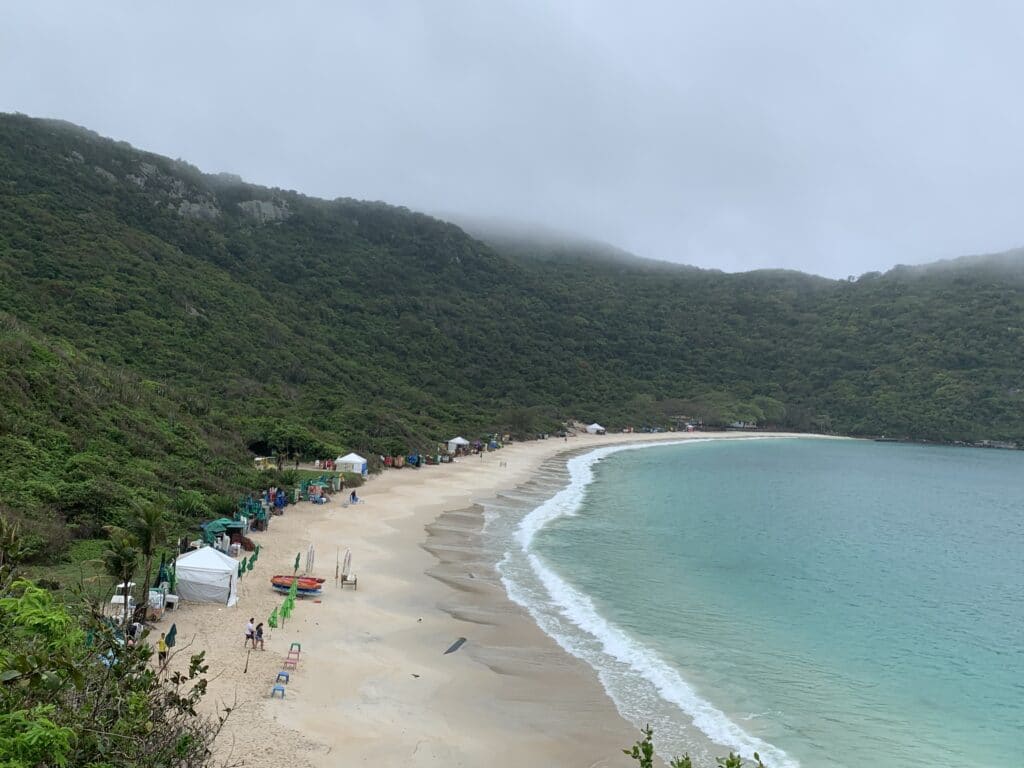 Praia do Forno
Praia dos Anjos
Praia dos Anjos is where the fishing boats depart from and return, loaded with fish for the market, along with the tours to Praia do Farol. Even though it’s not the most recommended beach for swimming, it’s certainly one of the most important and busiest in the region.
It’s also one of the busiest, with shops selling souvenirs and restaurants, and because of the port, plenty of people coming and going.
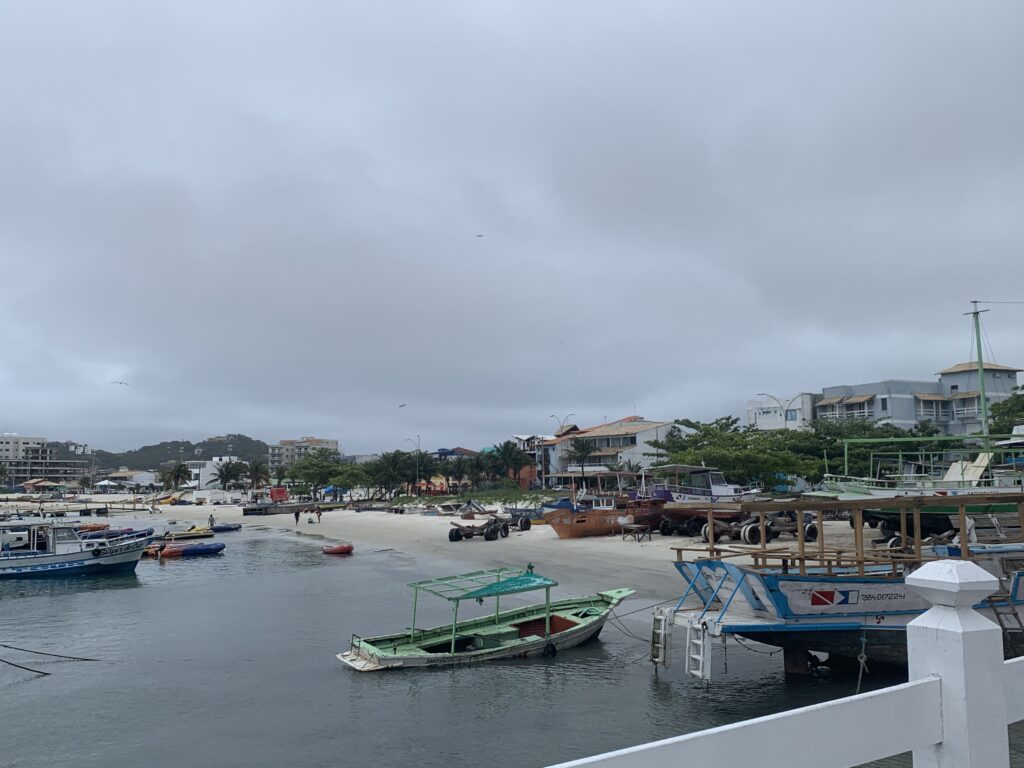 Praia dos Anjos
It’s also historically significant, since this is where Amerigo Vespucci landed in 1503 to begin colonizing the region. The Igreja Nossa Senhora dos Remédios was built here, site of Brazil’s first enclosed Mass, and it’s still standing near the port, in excellent condition.
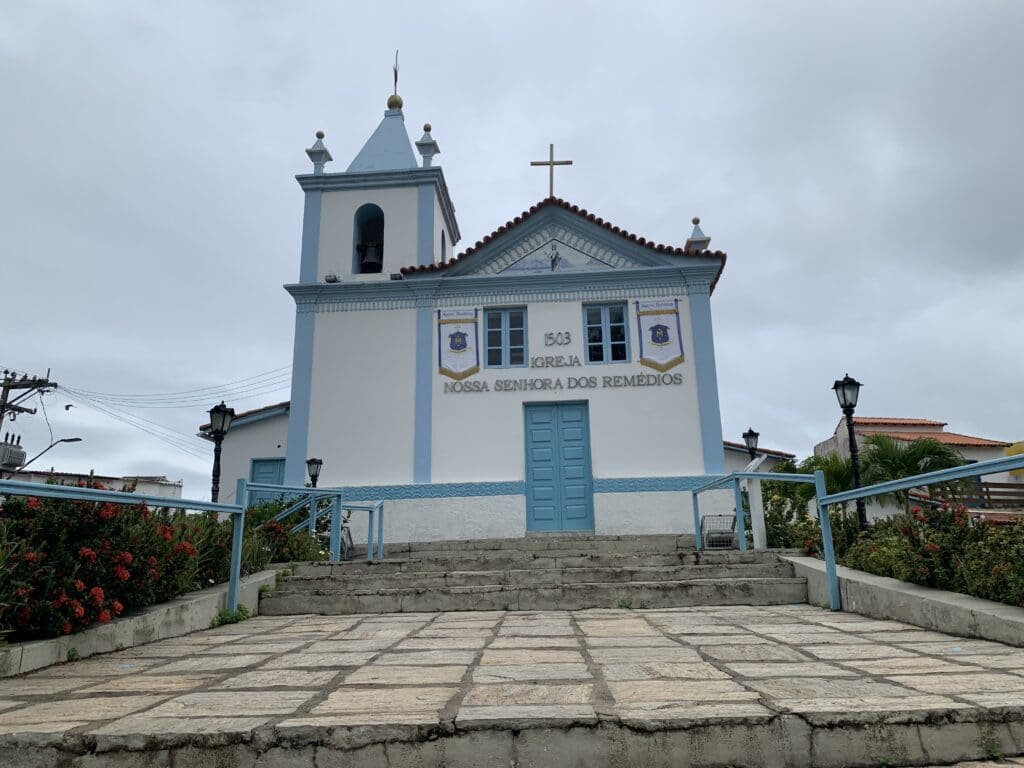 Igreja Nossa Senhora dos Remédios
Prainha
One of the region’s most popular and central beaches, Prainha is developed, with kiosks and calm water. It’s also a good place to stay. The beach is currently undergoing revitalization, and a lookout is being built in the area.
On the right side facing the beach, there’s a trail leading to Praia do Pontal, and between the two, there’s a trail leading up to the radio towers. But locals told us it’s dangerous to go alone, so we ended up skipping that trail and just heading to Praia do Pontal.
We stayed on this beach and enjoyed the area.
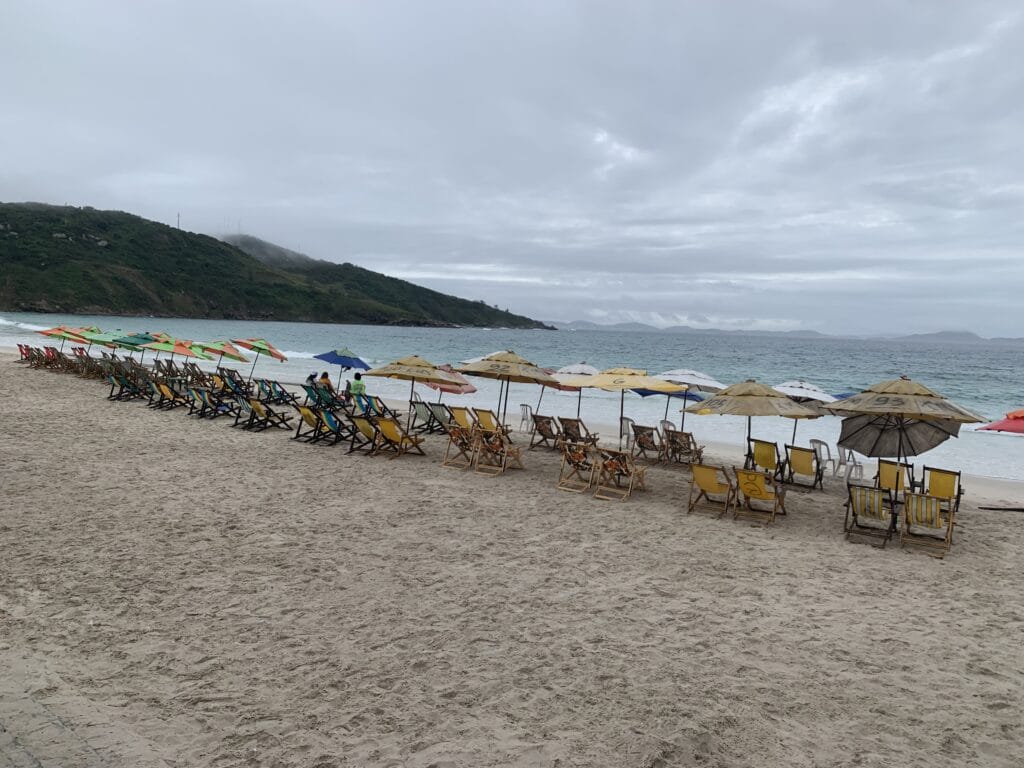 Prainha
Praia do Pontal
Access to Praia do Pontal is via a dirt road, just past the town’s entrance archway, with parking near the beach — worth checking out, since the beach is genuinely empty.
It’s the first beach in Arraial do Cabo, a continuation of the same stretch of sand as Praia do Forte, Dunas, and Foguete (Cabo Frio). The beach has a stretch of white sand as far as the eye can see, with clean, cold, blue water.
The beach has minimal infrastructure, though there are a few fishermen’s shacks where you can buy drinks, ice, and basic food.
There’s a visible trail along the beach leading to an easily accessible lookout, even with the uphill climb, though it’s quite slippery. I did the trail, and the view of the vast beach is beautiful.
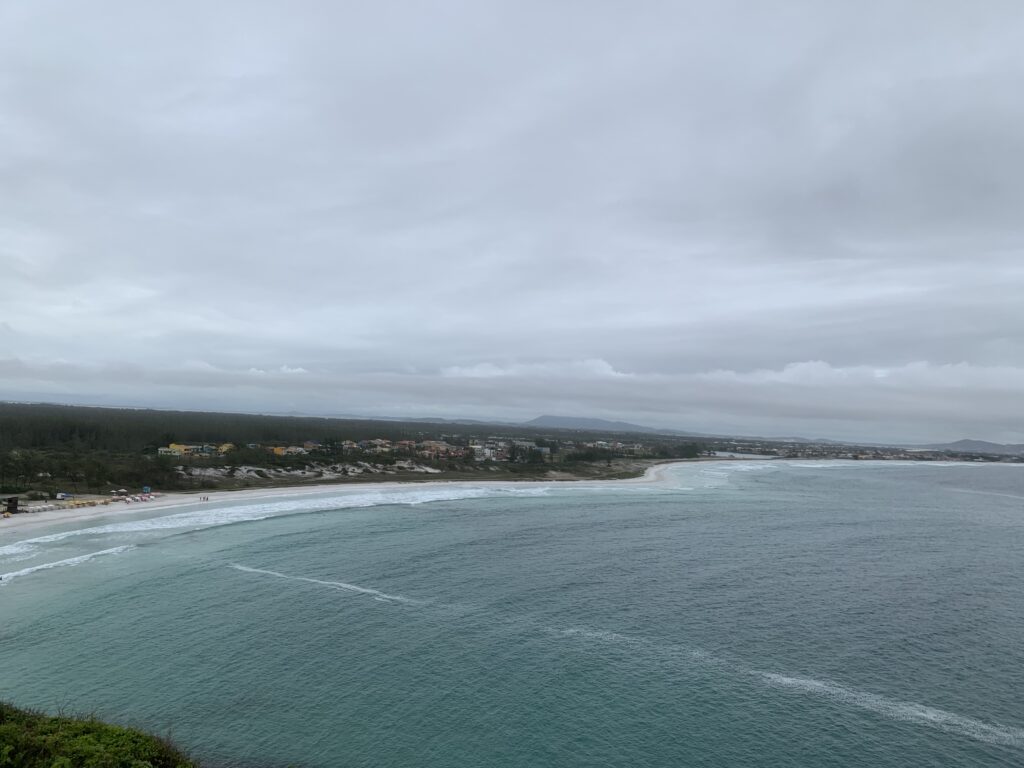 Praia do Pontal
Praia Grande
Praia Grande gets its name from genuinely being large. It stretches about 40 kilometers of sand, starting in Arraial do Cabo and running all the way to Saquarema.
It has a central location and full infrastructure, with shops and restaurants, making it one of the region’s most popular beaches.
There are two attractions here: the “Janela do Céu” (“Window to the Sky”), reached via a kind of trail climbing the hillside around the beach’s left edge, offering a beautiful view of the area, and it also has the best sunset in the region, since even sitting in the central part of town, its waters keep that same turquoise-blue color.
Because of overcast weather, we didn’t get great visibility of either the sunset or the window, but from the photos, both are unmissable spots.
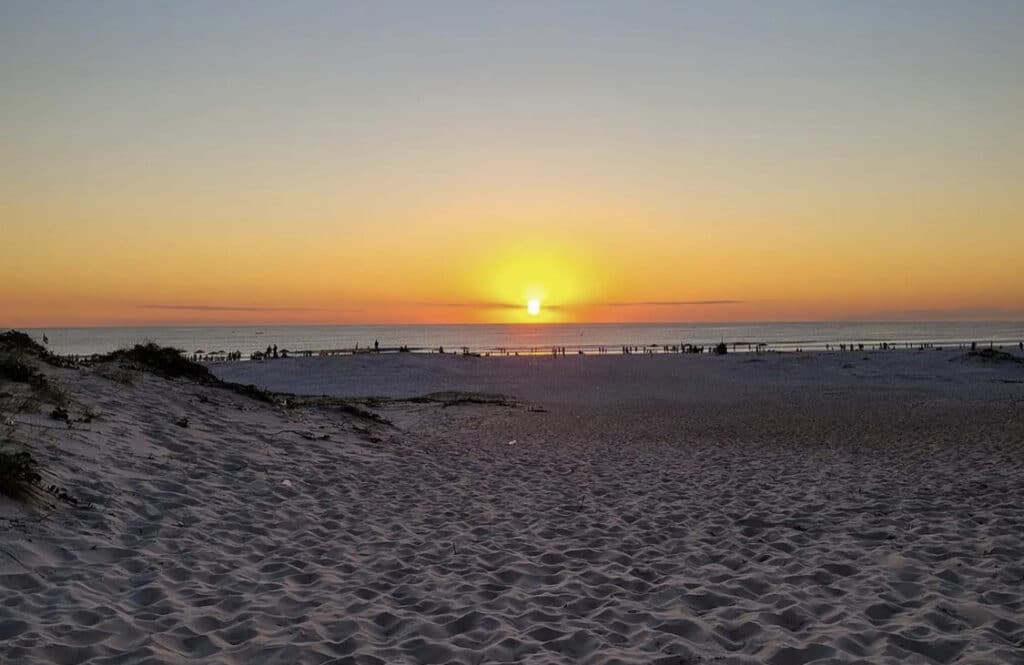 Sunset at Praia Grande
Diving in Arraial do Cabo
The clear water here makes diving easy, and the sheer amount of food available attracts abundant marine life to Arraial do Cabo. The variety of fish makes Arraial do Cabo a top-tier destination for diving, whether snorkeling or deep diving.
Unfortunately, I suffered a facial barotrauma while diving and can no longer do this sport, but here’s the tip for anyone who loves it!
Where to Eat in Arraial do Cabo
Arraial do Cabo, unfortunately, doesn’t have many restaurant options, and not many great ones either. For better dining, you’re better off going to Cabo Frio or even Búzios, but we did try two restaurants.
Sol na Cozinha
Sol na Cozinha (Instagram) is hard to find parking for, but it has the best cooking in the region, with two different menus: the Menu Mares, served at lunch, and the Menu Sol na Cozinha for dinner. We ended up having lunch there, but we’d recommend going for dinner instead, since the second menu has far more options.
For starters, we ordered the Truffled Shiitake Arancini (R$28.00), which was okay. For the main course, we chose a Poke Mares (R$42.00), made with tuna, which was tasty, and an Oriental Stroganoff (R$59.00) with shrimp, whose sauce was good.
For dessert, Sonho de Tapioca (R$26.00), a mini tapioca sonho with dulce de leche and the house’s coconut ice cream, was also good.
The space is small but cozy, though service is quite slow, so come with plenty of patience!
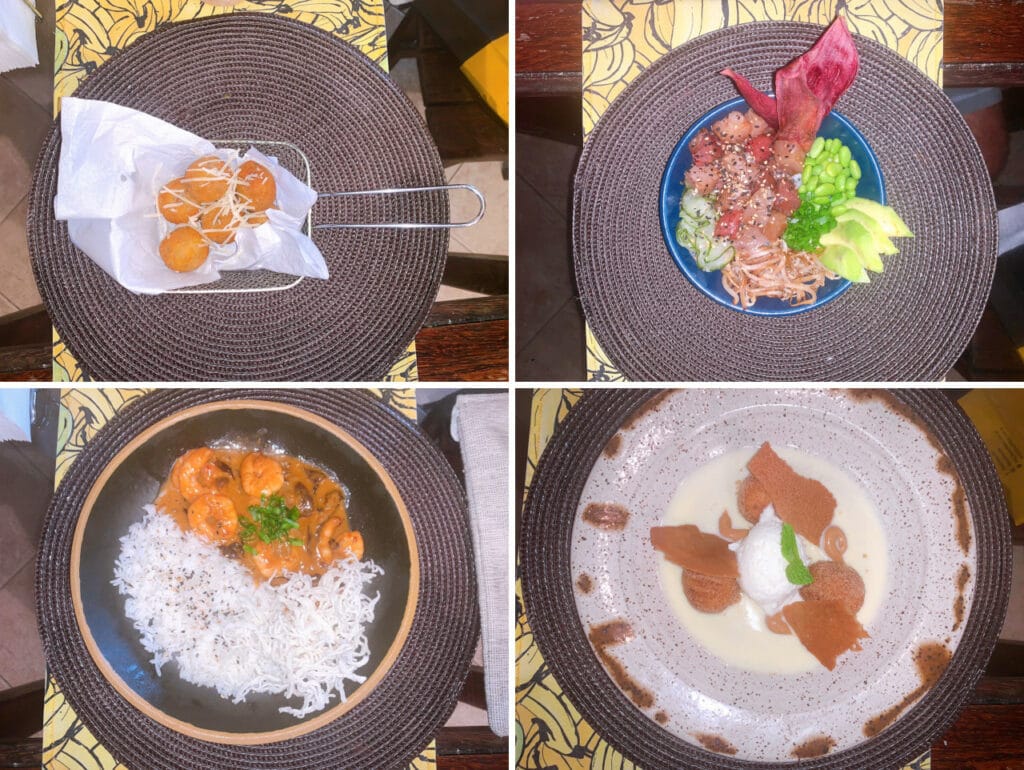 Restaurante Sol na Cozinha, Arraial do Cabo
Casa da Piedra
Casa da Piedra (Instagram) was built in 1506 by the Portuguese and is considered one of Brazil’s first trading posts. Despite all that history, we’d recommend not even bothering to go in.
Honestly, the restaurant gets everything wrong: terrible service, dishes that took over an hour to arrive, and came out awful when they finally did.
For our main course, we ordered the octopus with risotto (R$92.00), where the risotto was extremely hard and salty. I ordered a fish with shrimp sauce (R$79.00), where the fish had a terrible taste and the shrimp was dried out.
Dessert prices are outrageous. For example, a Grand Gâteau (R$55.00), and a Grand Banoffee at the same price.
So unfortunately, we don’t have a great recommendation for the area. But we think Sol na Cozinha is worth going back to, to try dinner, which has more varied options.
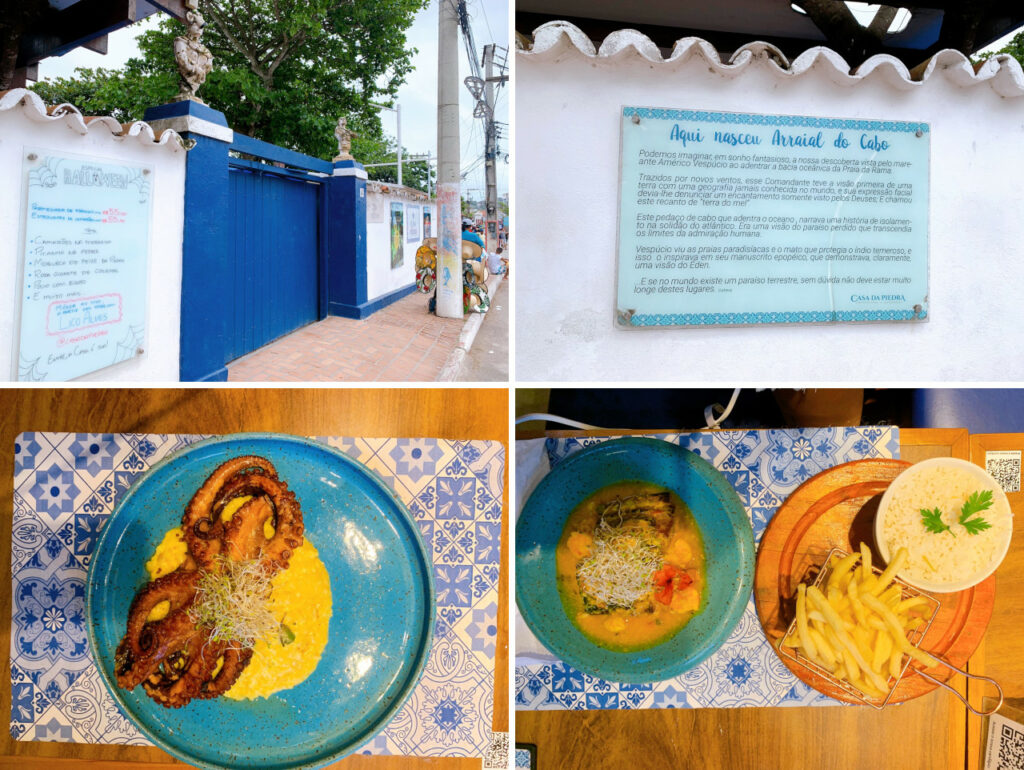 Restaurante Casa da Piedra, Arraial do Cabo
Read more about Maragogi, another Brazilian Caribbean, and Cabo Frio.
Read the original version in Portuguese on A Bela e o Bigode.