What to Do in Lyon in One Day
Lyon is a simply fantastic city and deserves more than a single day’s visit, but we fit it into our itinerary while traveling to Burgundy and only set aside one day for it — though we’d recommend at least 2 full days to explore the city properly and really enjoy it.
To start, Lyon is France’s third-largest city, which is one more reason to set aside an extra day for it. Attractions like the Roman amphitheater Trois Gaules, the Basilica of Notre-Dame, and the Museum of Fine Arts are a few of the places that shouldn’t be left off any itinerary.
The Auvergne-Rhône-Alpes region is also one of the most beautiful in France, and sits close to Switzerland, making it easy to visit other incredible cities nearby.
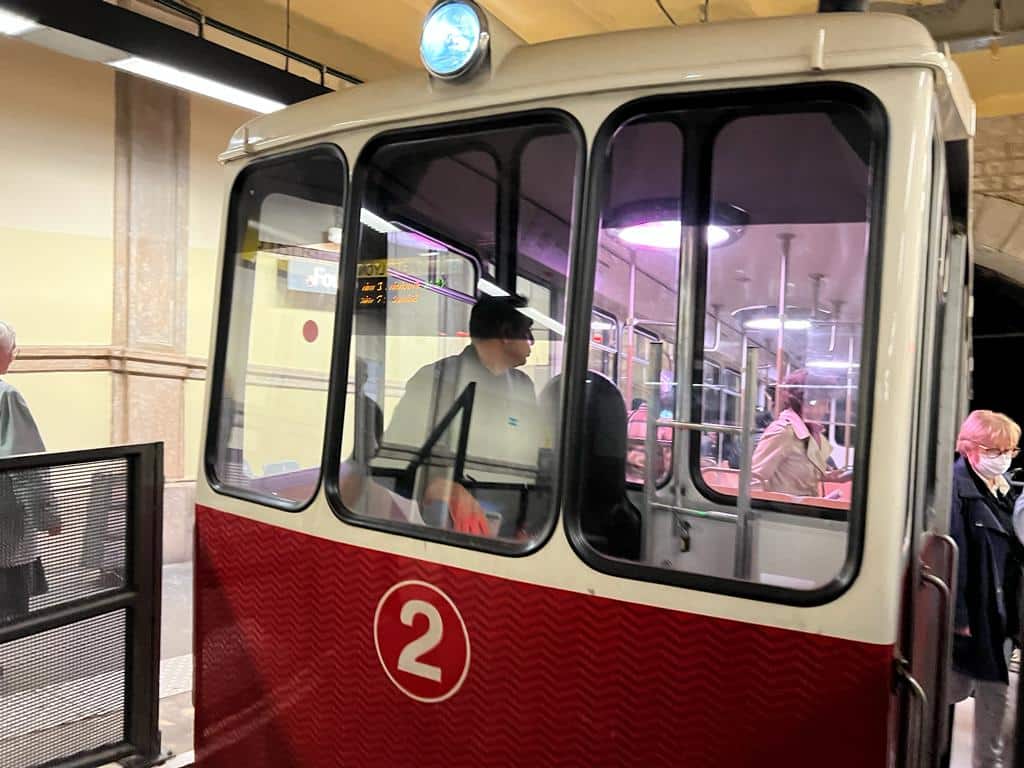
We covered most of the city on foot, except for the climb up to the Basilica of Notre-Dame, which we did by funicular — a very touristy way to get around town, and one that saves you from a very steep climb.
The city’s food scene is well known, and considered by many to be the best in France, and it’s also among the best in the world. To put it in perspective, Lyon has 15 restaurants with a Michelin star, while Brazil as a whole had only 14 starred establishments total (2021) — so we’d definitely recommend building in a proper dining experience, something we didn’t have time for ourselves.
Getting to Lyon
Lyon sits south of Paris, and we decided to drive, since, as mentioned, we were making our way through the towns of Burgundy and stopping along the way. If you’re heading straight from Paris to Lyon, though, the trip takes about five and a half hours on average.
Another option is the high-speed train — about 31 trains a day cover the 426 km between the two cities in around two hours on average, operated by TGV inOui, Swiss Railways (SBB/CFF/FFS), Trenitalia, and other companies.
You can also catch a bus from Paris, which is the cheapest way to reach Lyon. The trip takes about six hours on average, operated by Blablabus and FlixBus.
What to do in Lyon
Place Bellecour
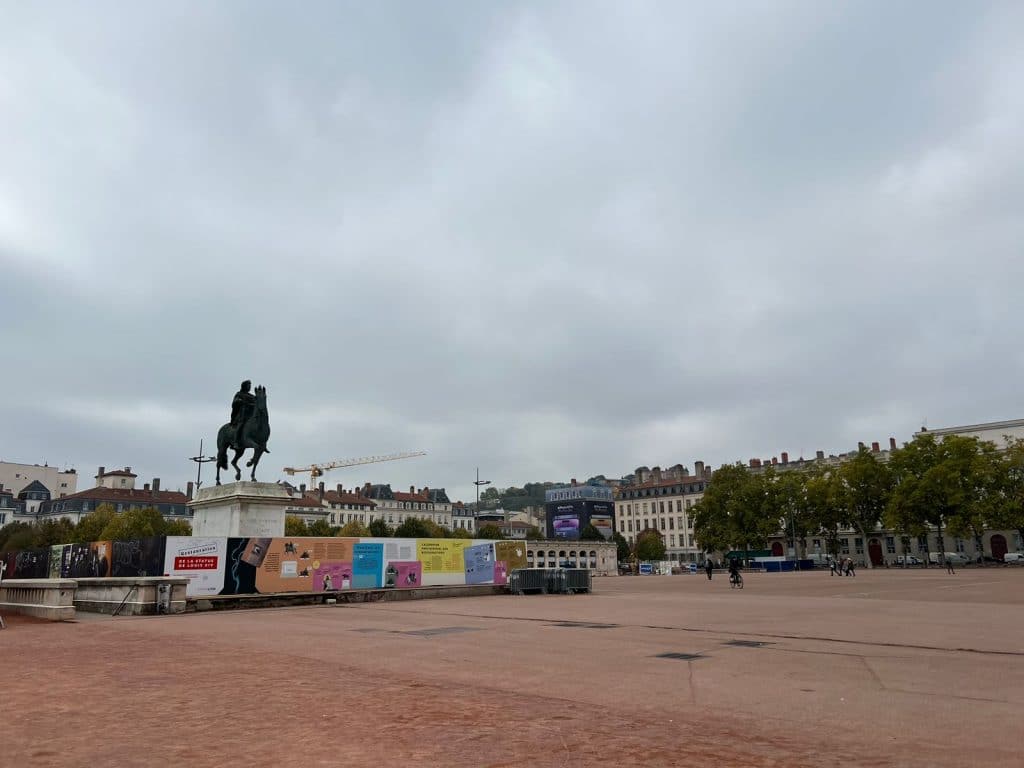
Place Bellecour is a large square in the center of Lyon, France, measuring 312 m by 200 m. It’s one of the largest open squares in Europe and the third-largest square in France, behind Place des Quinconces in Bordeaux and Place de la Concorde in Paris.
Take in the equestrian statue of Louis XIV, standing proudly at the heart of the square. The tourist information office and the central post office are also housed here, in the square’s imposing buildings.
We’d recommend eating at one of the restaurants or cafés with tables spilling out across the square.
Near the square, you’ll also find the Opéra Nouvel and the Cathedral of Lyon.
On the western side of the square, look for the statue of the Little Prince, from the famous children’s story by Antoine de Saint-Exupéry. It honors the legendary writer, who was born in Lyon, depicting him seated in front of his literary creation.
Cathedral of Lyon
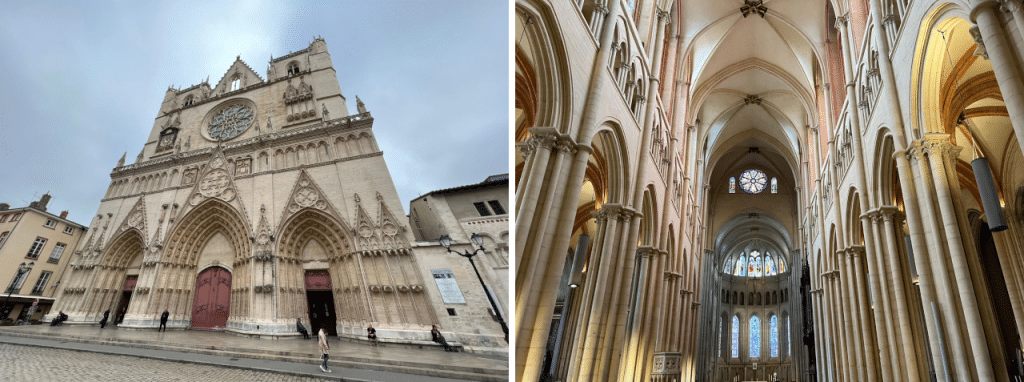
The Cathedral of Lyon was built between the 12th and 15th centuries and retains its original Gothic-style character.
Most of the cathedral’s stained glass dates to around 1300. During World War II, the panels were removed to protect them from damage.
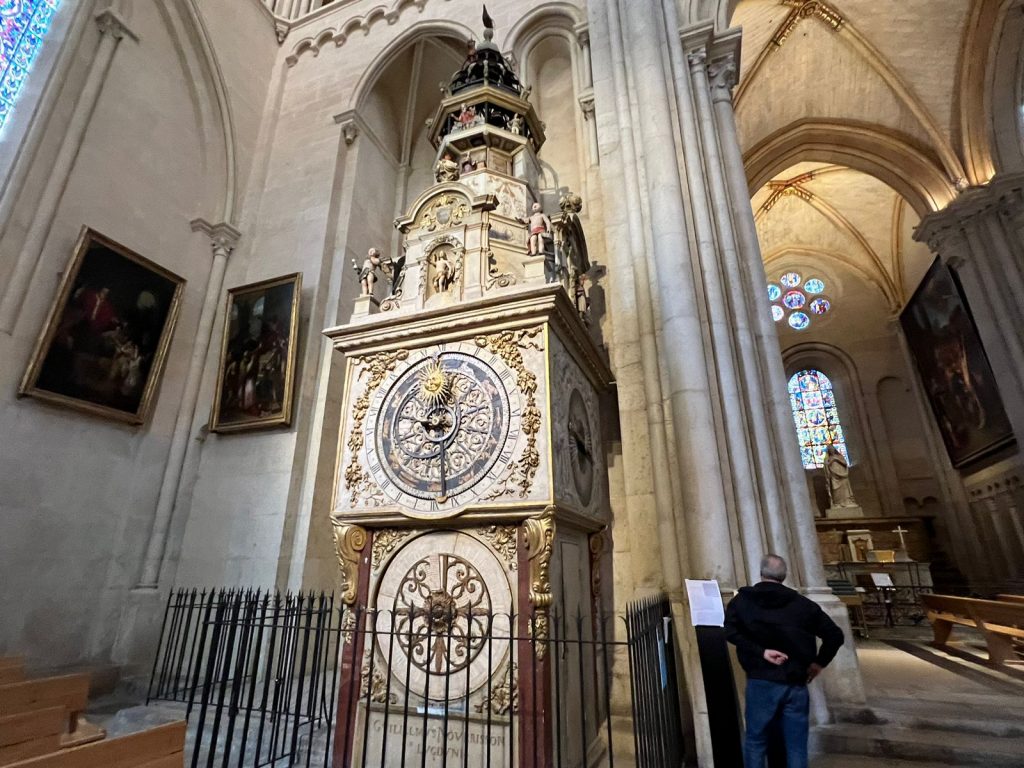
Inside the Cathedral of Lyon, you’ll also find a 9-meter-tall astronomical clock. Installed sometime between 1300 and 1600, it draws plenty of attention and curiosity from visitors.
Basilica of Notre-Dame de Fourvière
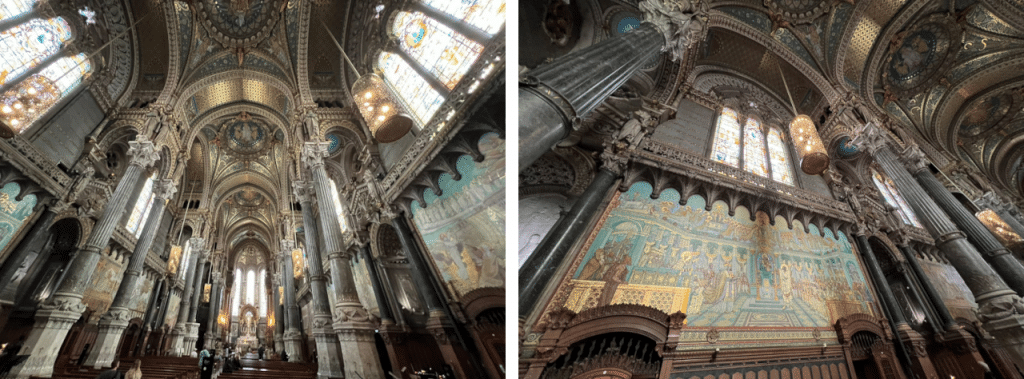
This church sits atop Fourvière Hill, the city’s oldest quarter, and it’s among the most beautiful churches I’ve ever visited anywhere in the world — its interior is even more beautiful and striking than its already imposing exterior, covered entirely in gold, marble, stained glass, incredible mosaics, and paintings.
Built between 1872 and 1884, the basilica sits atop an ancient Roman forum and blends elements of Byzantine and Romanesque architecture.
Inside, you’ll find the Museum of Sacred Art and the crypt of Saint-Jean; outside, there’s a terrace beside the Chapel of the Virgin, offering a panoramic view over Lyon.
Admission is free, and as mentioned, we rode the funicular up, which we found to be an incredible experience — especially since the walk up on foot is quite steep.
Ancient Theatre of Fourvière
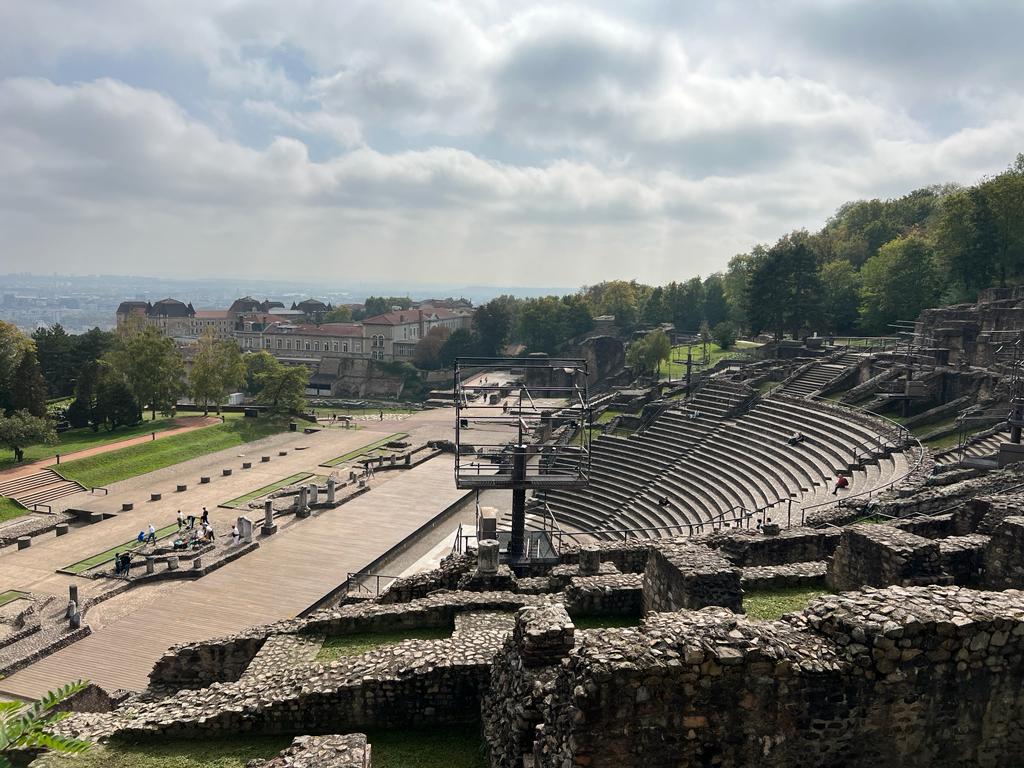
The Roman Theatre of Fourvière is the oldest Roman theater in France. It was built in 15 BC under Augustus and later expanded under Hadrian, with work wrapping up in 17 AD.
At its peak, the Theatre of Fourvière held 10,000 spectators, though over time part of its structure has been lost.
Next to the theater is Lugdunum, a museum built right into the surrounding stonework, telling the story of the site — well worth grabbing the audio guide to better understand the history here.
Paired with the main theater is the Odeon, built in the early 2nd century, holding 3,000 people. Behind the Ancient Theatre of Fourvière, you can also visit the ruins of an ancient Roman temple, dedicated in 160 AD to the goddess Cybele.
It was restored in the 20th century and today hosts events like concerts and performances, especially during summer.
The Ancient Theatre of Fourvière is part of Lyon’s UNESCO World Heritage designation.
Les Halles de Lyon Paul Bocuse (Public Market)
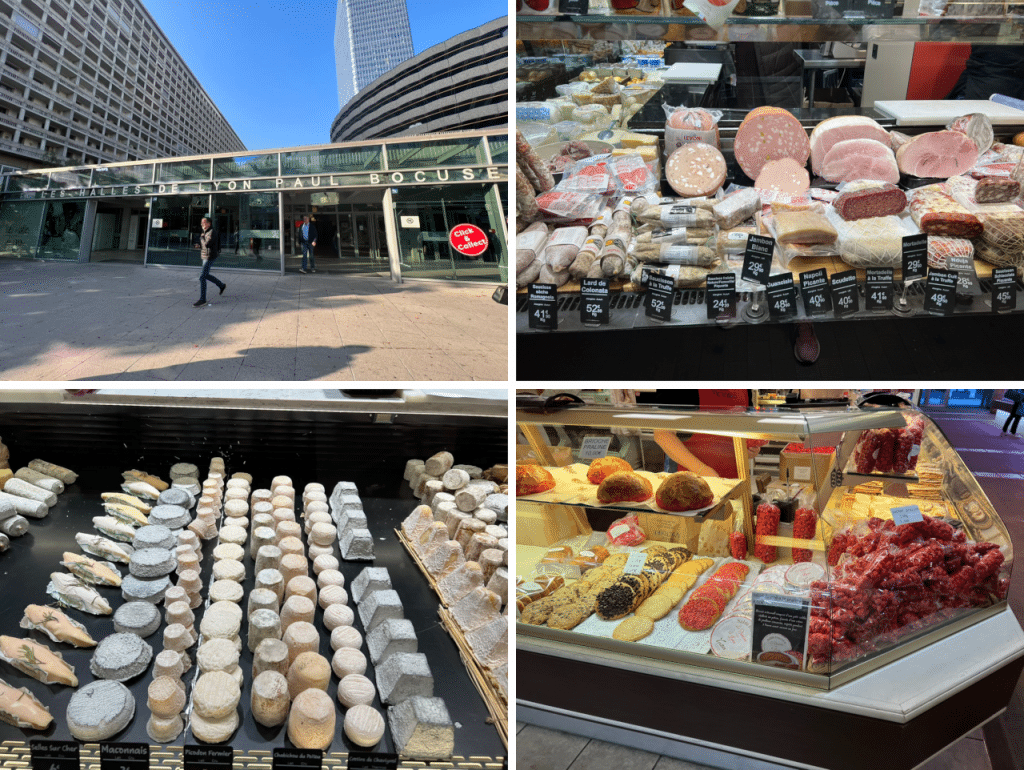
France is known for its excellent food and celebrated chefs. Among them, Paul Bocuse, who lends his name to Lyon’s public market. The market brings together an incredible variety of high-quality foods, all ready for you to enjoy.
In 1859, Lyon opened its first enclosed food market inside a large metal structure on Place Cordeliers, in the city center.
A hundred years later, the city decided to build a new indoor market to reflect its commitment to gastronomy, naming it after the city’s famously celebrated chef, Paul Bocuse.
The market houses 48 vendors, representing a wide range of products, including butchers, bakeries, chocolate shops, and wine and spirits stores.
Lyon’s Street Murals
One of the things to do in Lyon is check out its street murals.
There are about 100 paintings scattered across buildings, walls, and homes throughout Lyon, many of them in less touristy neighborhoods.
The États-Unis neighborhood is one of the best known, home to 25 murals telling the story of architect Tony Garnier, who designed the suburb in the 1920s.
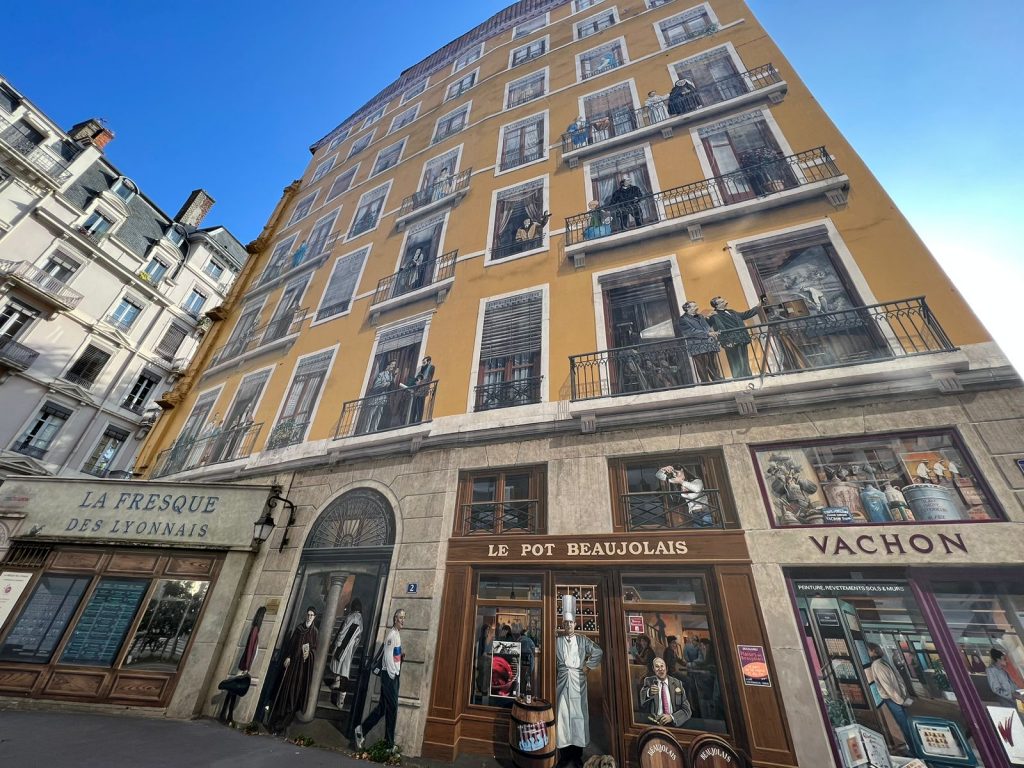
“La Fresque des Lyonnais” (The Lyon Mural) is a large-scale mural covering the back and side of a bright yellow building in Lyon, France.
The murals of Lyon feature 24 historical figures and six contemporary ones, including Antoine de Saint-Exupéry with the Little Prince, the Lumière brothers, pioneers of cinema, and Paul Bocuse, the father of French gastronomy. They’re painted at street level, so they appear to interact with today’s residents and visitors.
The mural was painted by the artist cooperative “CitéCréation” between 1994 and 1995, as an effort to revitalize the busy central intersection of one of Lyon’s most central, high-traffic neighborhoods, and as a tribute to these towering figures.
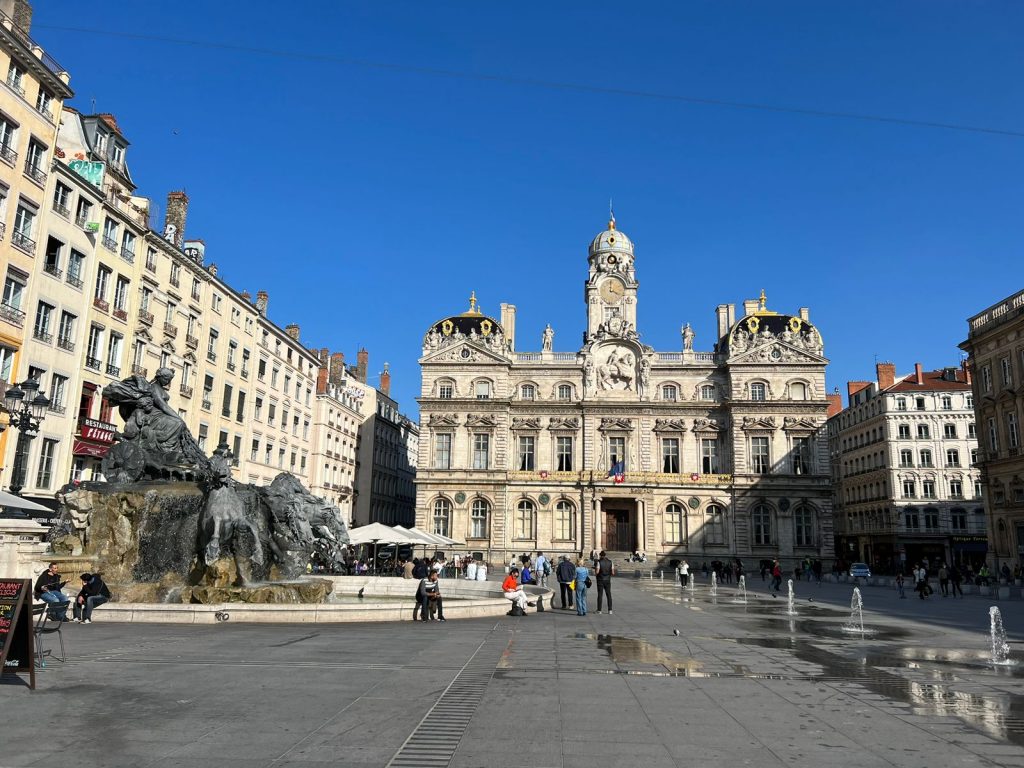
Place des Terreaux
This square’s fountain came out of a design competition held for Bordeaux’s City Hall on April 20, 1857.
The competition’s winner was Frédéric Bartholdi, then just 23 years old. Bordeaux’s City Hall ultimately decided not to move forward with his design, though it was finally completed in 1888 — only to be judged too expensive, and sold to Lyon instead.
It was unveiled as part of the 1889 World’s Fair (Exposition Universelle). The fountain ended up installed at Place des Terreaux, where it still stands today.
The fountain depicts France as a woman (Marianne) seated in a chariot, steering the four great rivers of France, represented by rearing horses plunging forward wildly, each highly individualized yet symmetrically arranged, with reins and bridles made of aquatic weeds.
Place de la République
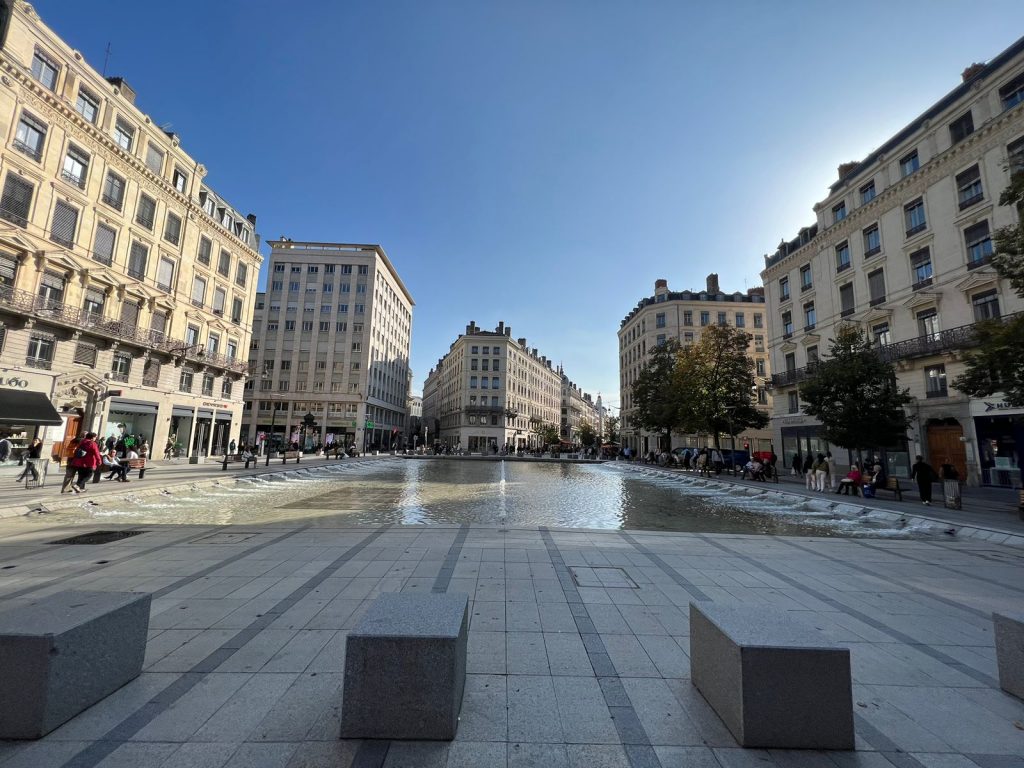
Place de la République, built in the second half of the 19th century, is a square located in the Bellecour neighborhood. It’s crossed by Rue de la République along a north-south axis, and falls within the zone designated as a UNESCO World Heritage Site.
Parc de la Tête d’Or
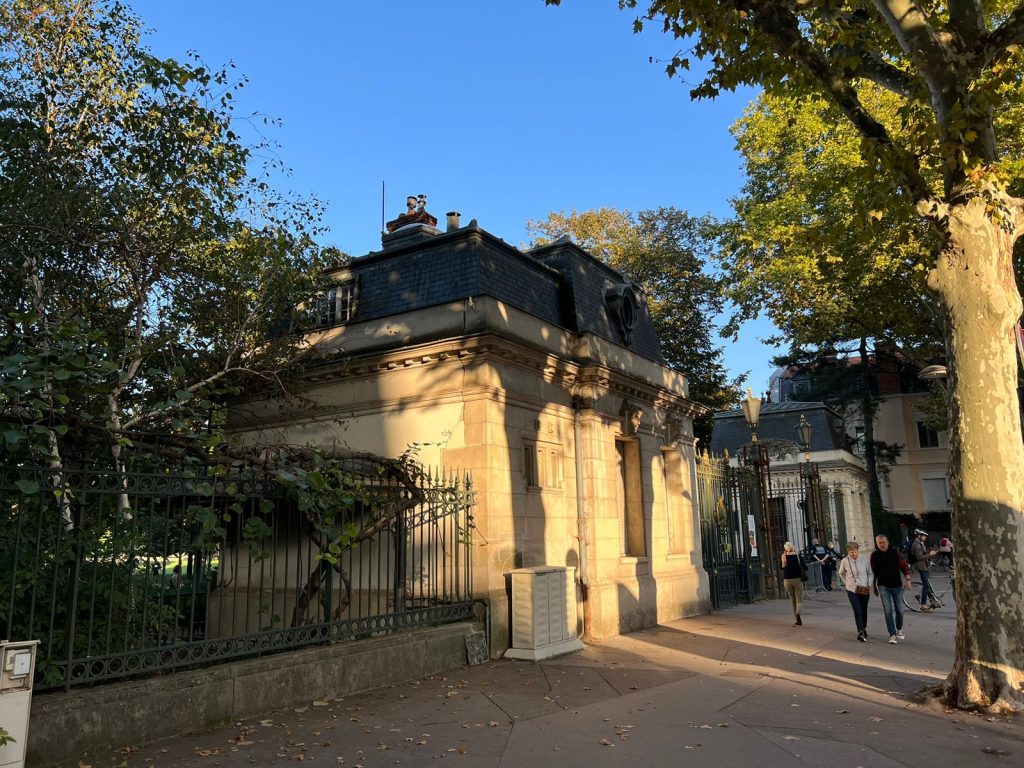
Parc de la Tête d’Or in Lyon is the city’s largest park and one of the best places to visit while you’re there. It covers 100 hectares and is home to a zoo, a miniature train, and a lake with paddle boats.
Created in 1857 by brothers Denis and Eugène Bühler, the same year as New York’s famous Central Park, Parc de la Tête d’Or has seen numerous additions since it was first built, including a glasshouse with plants from around the world and a rose garden.
Groupama Stadium
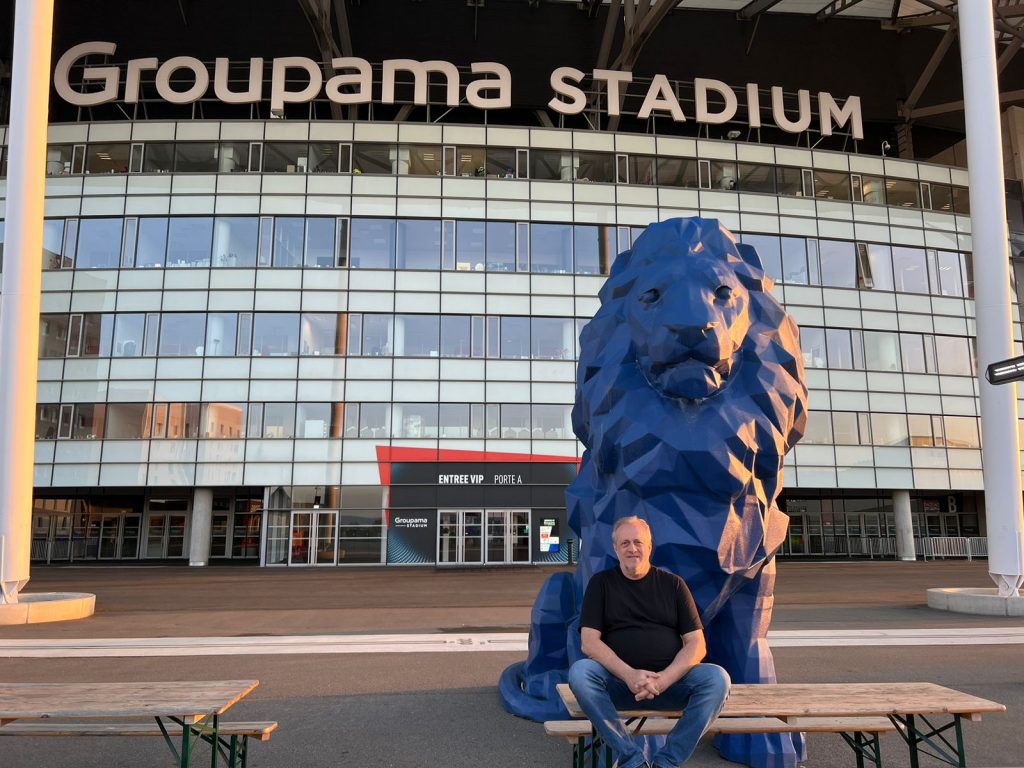
This stadium belongs to the investment group OL Groupe and replaced the club’s previous home, Stade Gerland. Its cost is estimated at around €250 million.
It was one of the venues for UEFA Euro 2016, and also hosted the 2017–18 Europa League final and served as one of the venues for the 2019 FIFA Women’s World Cup.
The stadium has an impressive team store, along with several restaurants around the grounds that are absolutely worth checking out.
What to eat in Lyon
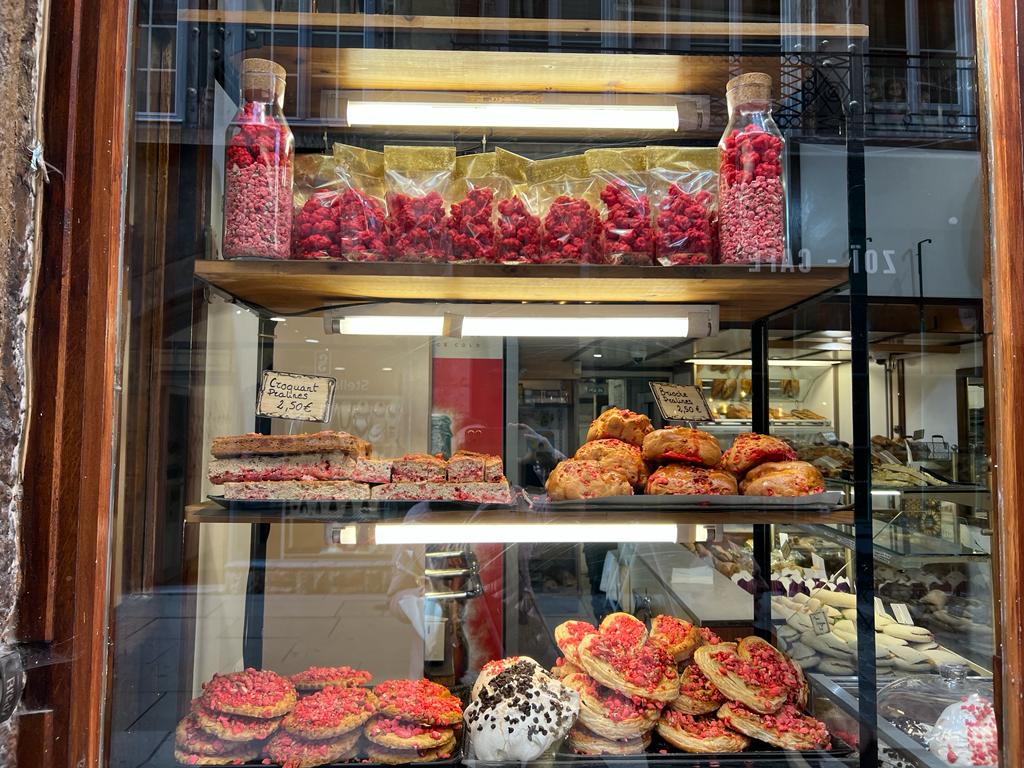
Praluline
You’ll find this on shelves in bakeries all across the city. Praline is widely used in French pastry-making, whether as part of a dessert recipe (fillings, toppings), eaten on its own, or in a creamy, paste-like form spread onto something like a pain au chocolat.
The treat itself, pink praline, blends almonds, hazelnuts, sugar, and food coloring. A 19th-century creation, elevated in Lyon into brioche form.
The most famous version is, without question, the praluline: half brioche, half praline, striking the exact right balance between butter and pure indulgence. It’s been made since the 1950s by Maison Pralus, and you’ll find it warm, its scent filling the streets wherever you go.
Read more about our trip in What to Do in Burgundy.
Read the original version in Portuguese on A Bela e o Bigode.